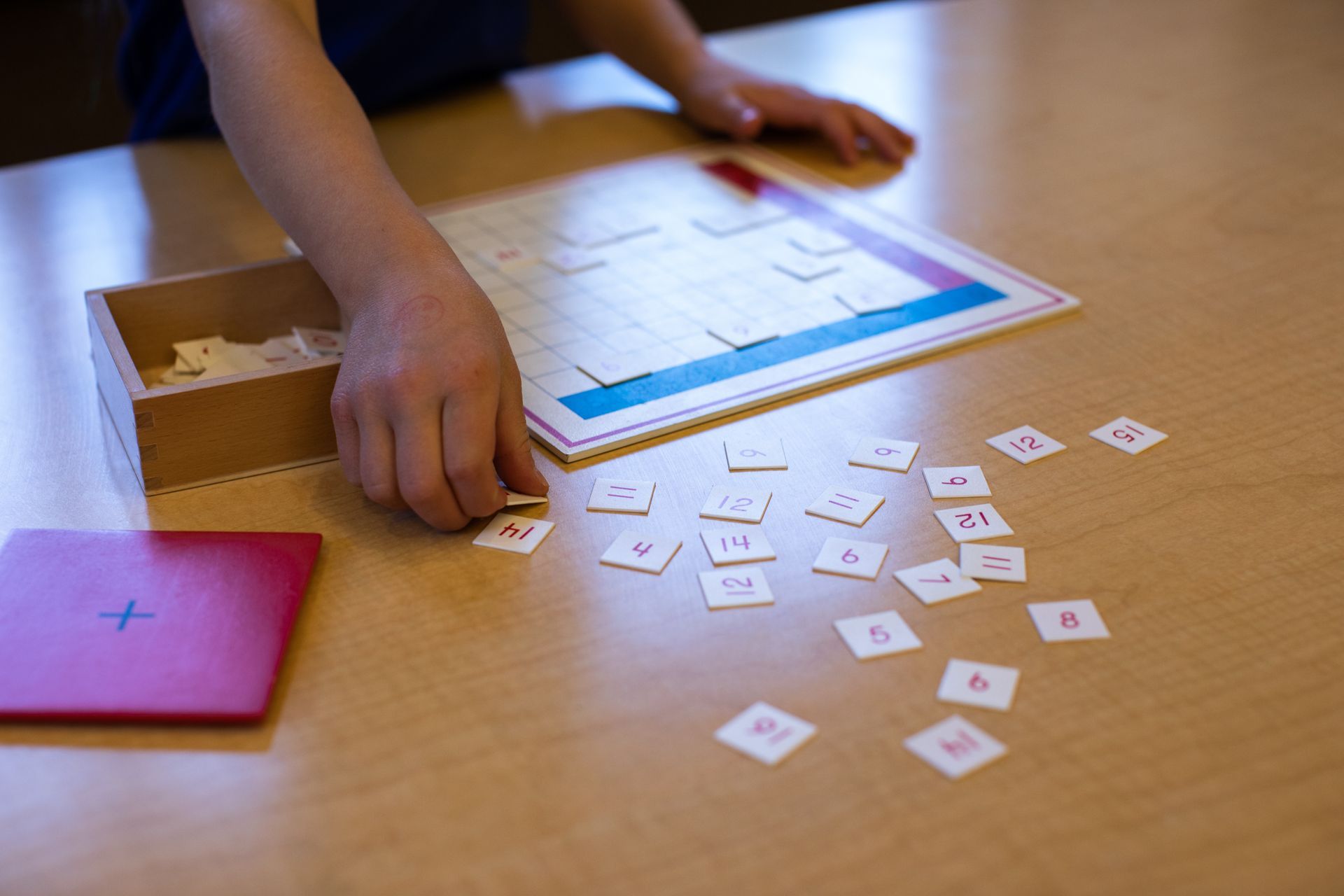
When the topic of math fact memorization comes up, people tend to hold strong opinions. We all carry our own childhood experiences with flashcards and timed tests, and those memories—combined with evolving views on modern education—frequently trigger heated debates.
Recently, research on math instruction caught our attention. At first glance, the findings might seem to challenge core Montessori principles. But upon closer examination, nothing could be further from the truth. In fact, Montessori methods provide children with the exact structural support this research highlights.
The Research Findings
In an article for Psychology Today, Dr. Paul L. Morgan (Director of the Center for Educational Disparities Research at Penn State) shared research conducted alongside colleagues George Farkas and Steve Maczuga. Investigating instructional practices in first-grade math classrooms, the team reached an unexpected conclusion: the only teaching method with a consistently positive impact on student achievement was teacher-directed instruction, as opposed to student-centered learning.
Before Montessorians audibly gasp, let’s look at how the researchers defined "teacher-directed":
“Teachers initially demonstrate specific procedures for solving problems, and then provide students with repeated opportunities... to independently practice these procedures. Teacher-directed practices should help students increase their procedural fluency... resulting in more effective use of higher order thinking and problem-solving skills.”
What Does This Look Like in a Montessori Classroom?
When stripped of conventional educational jargon, this definition describes the exact framework of a Montessori math presentation.
The initial surprise stems from common misconceptions about our environment. Many assume Montessori children run entirely free without explicit guidance. In reality, Montessori operates on choice within limits. Guides carefully design the environment and deliver direct, explicit lessons demonstrating how to use each material.
When it comes to basic operations, Montessorians fully agree that foundational facts require speed, accuracy, and repetition. Understanding why numbers work is essential, but fluent recall frees up cognitive bandwidth so children can conquer complex multi-digit operations at an early age.
Montessori classrooms achieve this through hands-on, self-correcting materials that replace conventional worksheets:
- The Bead Cabinet & Chains (Ages 3+): Begins as skip-counting practice and naturally evolves into effortless multiplication recall and early exposure to squares and cubes.
- Addition & Subtraction Strip Boards (Ages 5–6): Allows children to explore numerical combinations, spot structural patterns, and build calculation speed.
- Multiplication & Division Bead Boards: Moves children from concrete visual grouping to abstract mental shortcuts.
- Finger Boards & Control Charts: Wooden equivalents of fact tables that offer immediate feedback, ensuring self-directed practice remains accurate.
- Record Papers (Blackline Masters): Paper templates where children record their work, cementing memory through written kinetic repetition.
Practicing Smarter: Targeted Progress
While our materials naturally encourage daily practice, we can always refine how children target their efforts.
Rather than having a child practice facts they’ve already mastered, guides can conduct brief 1-on-1 oral assessments. By checking off known facts on a progress matrix and leaving unmastered facts blank, the child receives a clear, personalized map of where to focus. This simple step transforms daily practice from repetitive routine into highly targeted growth.
Ultimately, Dr. Morgan’s research confirms what Maria Montessori recognized over a century ago: explicit initial instruction paired with purposeful, independent practice creates true mathematical fluency.
Come see math memorization in action.
Schedule a tour today!