July 20, 2026

Forget the Formulas: This Is How Children Really Learn Geometry

July 20, 2026

Forget the Formulas: This Is How Children Really Learn Geometry

Have you ever watched a child trace the outline of a window with their finger, or carefully line up blocks into a perfectly symmetrical row? They may not have a name for what they're doing, but they are already exploring geometry.


Dr. Maria Montessori understood that geometry is not an abstract school subject. It is part of the world children live in from the very beginning.


A glance at the typical geometry textbook might suggest otherwise. Formulas, diagrams, and definitions can feel remote and lifeless, something to be memorized and forgotten. But look around for a moment. There is geometry in the angles of a mineral crystal and in the symmetry of a butterfly's wings. There is geometry in the legs of a chair and in the steel girders of a bridge. Children encounter it everywhere!


In fact, research suggests that a basic intuitive understanding of geometric concepts may be inborn in human beings. A fascinating study of the Munduruku (an indigenous group living in the Amazon whose language includes very few spatial or geometric terms) found that both adults and children demonstrated an intuitive grasp of basic geometric ideas. This isn't something they were taught. It was already there.


Montessori classrooms build on exactly this kind of inborn understanding.


From Sensory Experience to Big Ideas


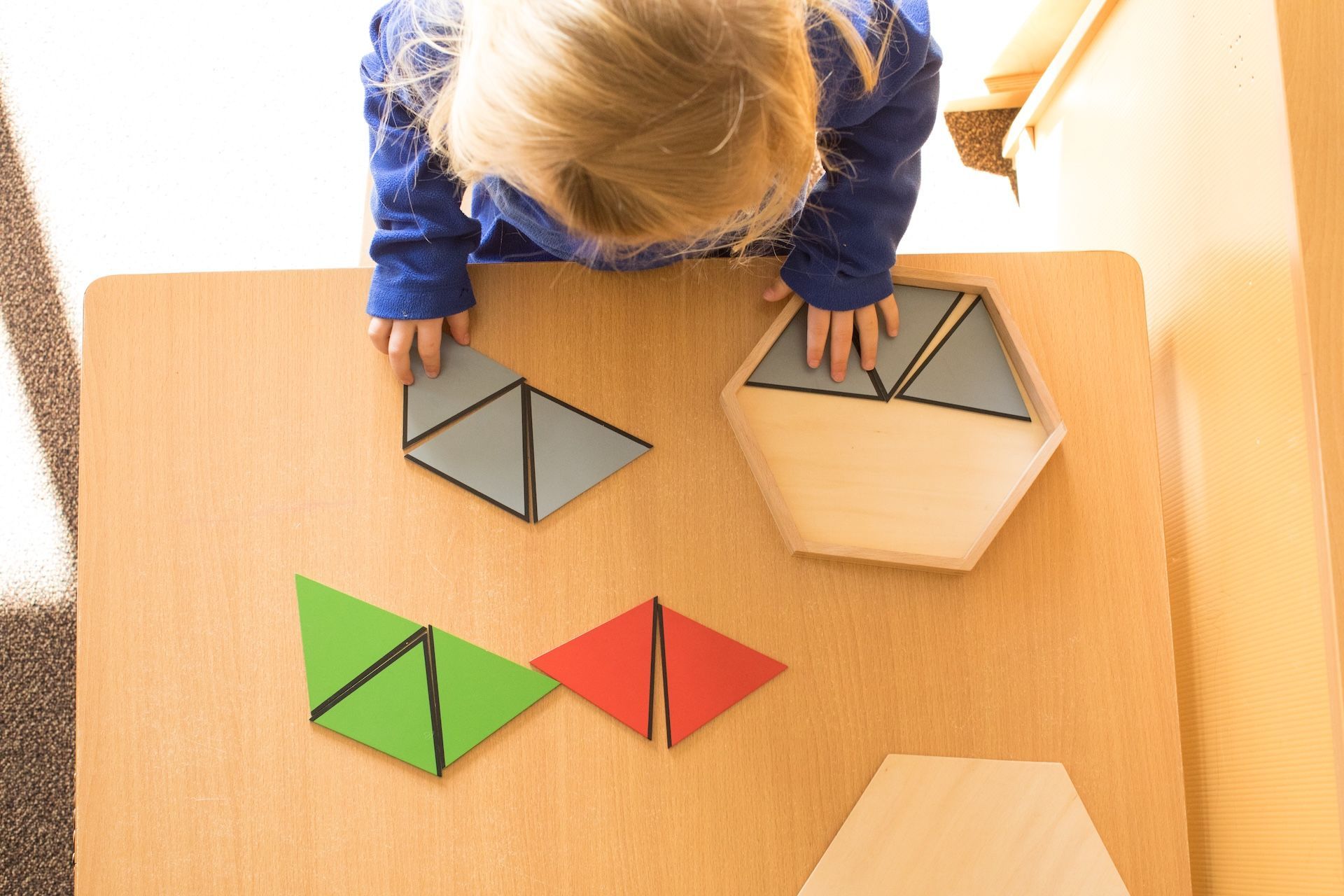
In the early childhood years, children work with geometry through their hands. Materials like the Constructive Triangles, the Metal Insets, and the geometric cabinet give children a felt, physical understanding of shape, symmetry, and form before we introduce any formal terminology. Children gather and store these impressions. Their minds are being prepared.


As they get older and certainly in the elementary years, children are ready to bring names and reasons to what they already sense. Elementary-aged children don't just want to know what something is called. They also want to know why. 


Why is this shape called a pentagon? (Spoiler: Its name comes from the Greek word for five: pente.) Geometry becomes a doorway into the history of language, ancient Greece, and the lives of mathematicians like Thales, Pythagoras, and Euclid, who puzzled over the same ideas thousands of years ago.


This is the spirit of Cosmic Education when we pull one thread of curiosity to find it unravels into history, language, culture, and mathematics!


Geometry, Algebra, and Arithmetic Woven Together


One of the things that makes Montessori's approach to geometry so distinctive is that it doesn't stand alone. In the Montessori classroom, geometry is part of a three-part approach to mathematics, interwoven with arithmetic and algebra in ways that make each of them easier to understand.


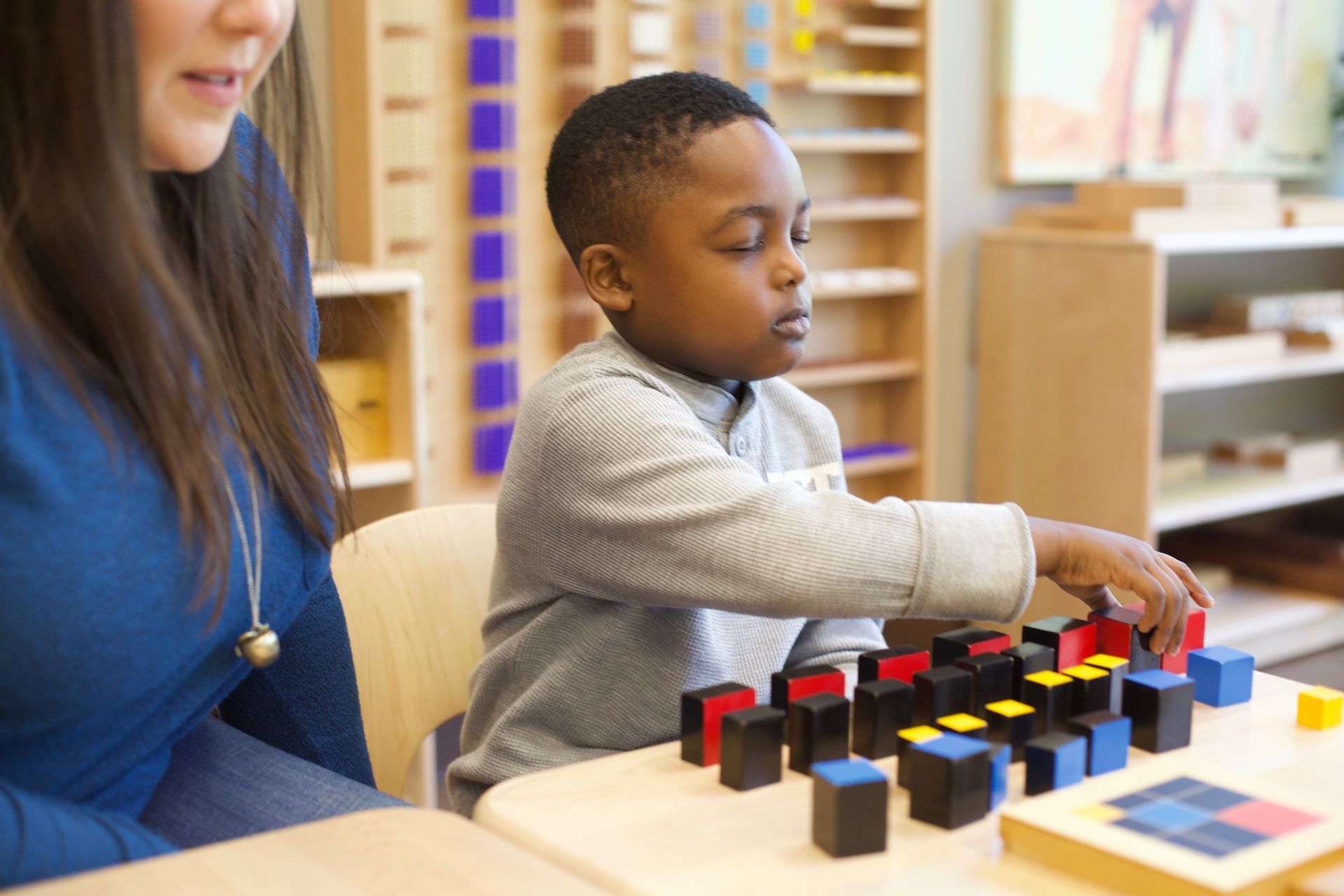
The Binomial Square is a good example. It presents the algebraic expression of (a + b)² = a² + 2ab + b² as a geometric pattern of squares and rectangles that children can actually build and hold. The arithmetic follows the pattern. The pattern confirms the algebra. Each one reinforces the others, and the whole thing is far more memorable than just a formula written on a board.


Open-Ended, Creative, and Genuinely Fun


Plus, a lot of Montessori geometry work has no single correct answer.


We invite children working with the Metal Insets or Constructive Triangles to find as many equivalent figures as they can for a given shape. There may be dozens of ways to approach the same problem. This open-endedness nurtures the creative, analytical thinking that elementary children are hungry for. Plus, this quality of thinking will serve them in every area of life.


Compass-and-straightedge constructions are another example. These beautiful, precise drawings challenge children in a way that is both mathematical and artistic. Many children find them deeply satisfying.


What This Looks Like at Home


You don't have to wait for the classroom to feed your child's geometric curiosity. Point out the shapes in a honeycomb. Notice the angles in a spider's web. Talk about the tiles on the floor or the panes in a window. Ask your child questions. Do you think that could be a triangle? How many sides does it have?


These small moments of noticing are the same thing Montessori described when she wrote about preparing the environment to reflect the world children already live in. Geometry is already there. We're simply helping children see it.


Come visit us in Gilbert, Arizona to see how this unfolds in the classroom and to watch children fall in love with one of humanity's oldest ways of understanding the world.
August 31, 2026
Raising children is a beautiful, surprising, heart-warming, and occasionally challenging adventure. When navigating the more difficult moments—whether it is a spilled snack, a forgotten chore, or a broken boundary—it can be tough to know the best way to respond. As humans, we all make mistakes, and we are constantly learning throughout our lives. How can we best guide our children through their mistakes in a manner that is both gentle and effective? In the Montessori environment, we look at these moments not as infractions requiring punishment, but as vital learning opportunities. By shifting away from arbitrary punishments and focusing instead on natural and logical consequences, we help children develop genuine responsibility and internal discipline. The Power of Natural Consequences Natural consequences are the outcomes that happen organically as a direct result of a person’s action or inaction. These consequences are never determined or enforced by an adult; they simply occur through interaction with the physical world. If a child decides not to wear a coat outside on a chilly Gilbert morning, the natural consequence is that they will feel cold. If they choose not to eat their breakfast, the natural consequence is that their body will feel hungry later. When your child experiences a natural consequence, the experience itself does the teaching. No negative parental intervention is necessary. In fact, adding an adult lecture or a reminder like "I told you so" actually detracts from the lesson. The physical reality speaks for itself, allowing the child to internalize the data and make a different choice next time. The Structure of Logical Consequences Logical consequences are implemented by an adult, but they are directly, logically related to the child's action. For example, if a child spills their snack on the kitchen floor, a logical consequence is to guide them to where the dustpan is and ask them to clean it up. The core distinction of a logical consequence is its intent: it is not a punishment designed to make a child suffer or repent. Instead, it is a supportive learning opportunity connected directly to the behavior. The goal is to give the child a chance to repair the situation, recognize the error, and learn how to avoid it in the future. When presenting a logical consequence, we must take great care to avoid shaming. The situation should be framed so that the child is never defined by their behavior. The behavior is simply an action that needs a constructive solution. When to Step In: Safety Boundaries Do these consequences really work? Yes, the vast majority of the time. However, there are absolute exceptions where an adult must step in immediately rather than letting a consequence play out: Physical Danger: When the child’s choices put their own safety at risk (e.g., running into the street). Harm to Others: When the action puts someone else's well-being in jeopardy. Delayed Feedback: When the natural consequence does not happen immediately enough to connect with the behavior. For example, sneaking extra holiday candy might be highly enjoyable in the moment, as the long-term health consequences are not immediate enough to make a meaningful impression on a young child. A How-To Guide by Development Stage When observing a safe natural consequence, resist the urge to rescue your child. The outcome may not be pleasant, but if it is safe, allowing them to feel the result of their choice is a gift that builds resilience. When creating a logical consequence, it is essential to keep it appropriate for your child's developmental capacity. A two-year-old who makes a large mess with their toys will need you to sit with them and guide them step-by-step through the cleanup. An elementary-aged student, however, is fully capable of handling the task independently. Here are a few real-world examples of how to apply logical consequences across different ages: The Primary Years (Ages 3 to 6) The Situation: A five-year-old was dancing while eating and spilled yogurt across the dining room floor. The Logical Consequence: Walk them gently through the restoration process. Bring them to the sink to retrieve a sponge, help them fill a small bucket with warm water, and demonstrate one or two wipes before passing the sponge to them to complete the cleanup. The Situation: A six-year-old was asked to clean up their building blocks before bed but left them scattered across the rug. The Logical Consequence: Let the child know calmly that because the blocks were left out, they will be placed in a temporary storage box in the closet for a few days before they can be used again. The Elementary Years (Ages 6 to 12) The Situation: An eight-year-old was playing baseball in the front yard where they were asked not to, and an errant ball broke a neighbor's window. The Logical Consequence: Work with your child to identify age-appropriate ways they can earn money or contribute household help to directly assist in paying for the replacement glass. The Situation: A twelve-year-old chose to spend their afternoon playing video games instead of completing their schoolwork, and they seem unbothered by the natural feedback from their guide at school. The Logical Consequence: Establish a clear environmental rule: video games or screen time may be accessed only after homework is completed and verified, not before. The Teenage Years (Ages 13+) The Situation: A newly-driving seventeen-year-old did not return home by the agreed-upon curfew. The Logical Consequence: Uphold a pre-established boundary regarding the family vehicle. Because the timeline agreement was broken, their independent driving privileges are paused for a specific, designated window of time. Keeping the Long-Term Goal in Mind Implementing natural and logical consequences requires an immense amount of parental time, consistency, and patience. Because this approach focuses on building long-term capability rather than short-term compliance, it is most effective when you have the emotional bandwidth to follow through completely. If we give in halfway through, the educational opportunity is lost. We also recognize the realities of modern family life. If your five-year-old spills yogurt just as you are rushing out the door for an important morning meeting, you may not have the time for a collaborative cleanup. In those moments, it is perfectly okay to say, "We need to go, so I am going to wipe this up quickly now. This afternoon, I'll show you how to use the mop so you're ready to handle it next time." Building resilient, self-disciplined children is a collective journey. If you ever want to discuss these strategies further or look at how we establish these behavioral boundaries in our Toddler, Primary, and Elementary environments, please reach out to your child's guide. We are always happy to share resources and support our family community. In addition, we invite you to schedule a tour to see natural and logical consequences in action in our school environment.
Sleeping child under a white blanket with a teddy bear nearby
August 24, 2026
Discover the four pillars of healthy sleep hygiene. Learn how to foster independent sleep, recognize sleep windows, and support your child's natural rhythm.